NOTA: El Departamento de Estado Norteamericano ha publicado con fecha de 31 de marzo su informe sobre la situación de los derechos humanos en Guinea. Difundimos la versión inglesa de ese informe y prometemos para los próximos días la versión en castellano de este mismo informe.
ASODEGUE 2 de abril de 2003
Equatorial Guinea
Country Reports on Human Rights Practices - 2002
Released by the Bureau of Democracy, Human Rights, and Labor
March 31, 2003
Equatorial Guinea nominally is a multiparty constitutional republic; however, in practice President
Teodoro Obiang Nguema and the small Mongomo subclan of the majority Fang tribe, which has
ruled since the country´s independence in 1968, dominated the Government. President Obiang,
who has ruled since seizing power in a military coup d´etat in 1979, was re-elected with 97.1
percent of the vote and 98 percent of registered voters participating in a December election marred
by extensive fraud and intimidation. The President´s Democratic Party of Equatorial Guinea (PDGE)
controlled the judiciary and the legislature; the latter was chosen in elections in 1999 that were
criticized widely by the international community as seriously flawed. The judiciary was not
independent.
President Obiang exercised control over the police and security forces through the Minister of the
Interior, who also served as President of the National Electoral Board. The Director General of
National Security was the President´s brother, Armengol Ondo Nguema. Civilian authorities
generally maintained effective control of the security forces; however, there were some instances
in which they acted independently of government authority. The security forces committed
numerous serious human rights abuses.
Although the 2002 census estimated the population at 1,015,000, credible estimates put the
number at closer to 500,000. The opposition claimed that the Government inflated the census in
anticipation of the December presidential election. The majority of the population lives by
subsistence agriculture, supplemented by hunting and fishing. Unemployment and
underemployment were very high. Barter was a major aspect of the economy. The gross domestic
product (GDP) grew by 23.8 percent during the year. Per capita income during 2001 grew to
$3,852. Much of the growth in income was due to an increase in crude oil, which averaged
280,000 barrels per day during the year. Investment and other use of oil revenues lacked
transparency despite repeated calls from international financial institutions and citizens for greater
financial openness. Poor fiscal management and a lack of transparency in public accounting of
national finances have undermined the country´s economic potential. There is little evidence that
the country´s oil wealth is being devoted to the public good. Most foreign economic assistance was
suspended due to the lack of economic reform and the Government´s poor human rights record;
however, some countries resumed aid during the year.
The Government´s human rights record remained poor; although there were some improvements
noted in a few areas, numerous serious problems remained. Citizens´ ability to change their
government peacefully remained somewhat restricted. The security forces committed numerous
abuses, including torture, beating, and other physical abuse of prisoners and suspects, which at
times resulted in deaths. Members of the security forces generally committed abuses with
impunity. Prison conditions remained harsh and life threatening. There were deaths in custody
from torture and abuse, combined with a continuing lack of medical care. Prisoners often were
tortured to coerce confessions. Security forces used arbitrary arrest, detention, and
incommunicado detention. The judicial system repeatedly failed to ensure due process and
remained subject to executive pressures. The Government restricted the right to privacy. The
Government severely restricted freedom of speech and of the press; however, freedom of speech
improved marginally during the year. The Government continued to restrict the rights of assembly
and association and limit freedom of religion and movement. There were no effective domestic
human rights nongovernmental organizations (NGOs). Violence and discrimination against
women remained serious problems. Discrimination against ethnic minorities, particularly the Bubi
ethnic group, and foreigners continued. The Government restricted labor rights. Child labor
persisted and forced prison labor was used. There were reports of trafficking in persons.
RESPECT FOR HUMAN RIGHTS
Section 1 Respect for the Integrity of the Person, Including Freedom From:
a. Arbitrary or Unlawful Deprivation of Life
There were reports of unlawful killings during the year. During the year, opposition parties and the
international press reported between three and five deaths subsequent to the June coup trial from
torture by prison authorities (see Sections 1.c. and 1.e.). For example, on July 3, police officer Juan
Odo Nguema died in Malabo´s Black Beach prison, reportedly due to torture. Nguema had been
sentenced to 6 years in prison for participating in the coup d´etat to oust President Obiang (see
Section 1.e.). Government authorities attributed Nguema´s death to bronchial pneumonia, a liver
abscess, and anemia.
There were reports during the year that prison authorities tortured, beat, and otherwise abused
prisoners; such abuse, combined with a lack of medical care, resulted in some prison deaths.
On February 15, the head of a military unit killed 35-year-old Dimas Bueriberi outside of Malabo
during a power outage. The shooter said he mistook Bueriberi, an electrician, for a bandit.
On October 7, Presidential Guard Army Commander Narciso Edu Nsue killed Luis Obiang, a
sergeant under his command, after both men had been drinking in a Malabo bar. Edu Nsue was
detained on charges of homicide and awaits a military tribunal.
The Government did not prosecute any members of the security forces considered responsible for
extrajudicial killings in previous years, nor is it likely to do so.
b. Disappearance
There were no reports of disappearances during the year.
c. Torture and Other Cruel, Inhuman, or Degrading Treatment or Punishment
The law mandates respect for the liberty and dignity of persons, but does not prohibit specifically
torture, cruel, or inhuman punishment. Members of the security forces tortured, beat, and
otherwise abused suspects, prisoners, and opposition politicians. After visiting prisons in 2001,
U.N. Human Rights Commission (UNHCR) Special Representative Gustav Gallon described
torture as a ”normal means of investigation.” The Government does not provide medical care to
prisoners or detainees.
There were reports that prison authorities tortured, beat, and otherwise abused prisoners, and that
such abuse, combined with a lack of medical care, resulted in the deaths of some prisoners (see
Section l.a.). There were credible reports of three such deaths in Black Beach prison during the
year.
There were reports that officials tortured opposition political activists subsequent to the coup trial
(see Section 1.e.). There were numerous reports that police authorities tied prisoners´ arms and
legs behind their backs and suspended them from a bar. During the trial, there was evidence that
prisoners suffered dislocated wrists and elbows, and many walked with a limp.
Torture commonly was used to extract forced confessions, particularly from the group of 144
alleged coup plotters arrested in March. For example, Felipe Ondo Obiang, leader of the banned
Republican Democratic Front (FDR), reportedly was tortured at Black Beach Prison in Malabo. His
hands were beaten so severely that he reportedly lost use of his fingers. He was not allowed
visitors, nor did prison guards accept food brought to Obiang from his family and friends. On June
9, Obiang received a 20-year prison sentence after a lengthy trial marked by many procedural
abuses.
On July 14, presidential guard soldiers at Black Beach prison beat Bibiana, the wife of imprisoned
Convergence for Social Democracy (CPDS) Secretary General Placido Mico, as she took food and
clothing to her husband.
During the year, security forces harassed oil company employees. For example, gendarmes
removed one employee from an oil company vehicle and beat him unconscious for refusing to pay
a bribe. A patrol boat also fired on an oil company boat without causing any injuries.
Local authorities singled out foreigners from neighboring countries for harassment such as verbal
intimidation and arbitrary arrest. Police routinely extorted money from citizens of Cameroon,
Nigeria, Ghana, Togo, and Benin.
The conditions of jails and prisons in the country remained harsh and life threatening; inmates
were not provided with food, medical care, working toilets, drinkable water, clean and healthful
living space, and minimum equipment, such as beds. There were credible reports that conditions
at Black Beach prison improved during the year, including facility renovations. In November 2001,
Special Representative Gustav Gallon paid an unauthorized visit to a Bata gendarmerie detention
center. Gallon reported 17 persons, including 4 children, were being held in a cell that measured 4
by 1.5 meters and did not contain toilet facilities. Two of the prisoners had clear signs of torture.
When questioned, the prison authorities did not deny charges of torture and could offer no
explanation for the prisoners´ detention.
Prison authorities and prisoners sexually assaulted female prisoners. Prisoners were used
habitually as labor and as workers on construction projects for certain officials, without pay or other
compensation. There were unconfirmed reports that judges used prisoners as domestic workers.
On July 29, various sources reported Black Beach Prison´s inmate food supply was exhausted,
and prison authorities no longer were distributing rice and peas to the prison population; however,
observers indicated that inmates were being fed by year´s end. Also in July, Black Beach
authorities hospitalized inmate Candido Obiang Abia for stomach cramps and high fever.
According to reports from other inmates, prison officials had not fed Obiang Abia in 4 days.
Male and female prisoners were not held in separate facilities, nor were adult and juvenile
prisoners. Pretrial detainees and political prisoners were not held separately from convicted
prisoners.
There were no local NGOs other than the government-controlled National Commission on Human
Rights of Equatorial Guinea (CNDH). In the past, the governmental-controlled CNDH has reported
that jail and prison conditions were harsh. Although the CNDH reported that prisoners were not
mistreated, CNDH reports indicated there were food shortages and a lack of medical care. CNDH
officials took partial credit for the Black Beach Prison facility renovations during the year. There
were no international human rights NGOs resident in the country. The International Committee of
the Red Cross (ICRC), which historically has made recommendations to the Government,
monitored prison conditions. On October 8, the ICRC signed an accord with the Government
institutionalizing its ability to visit detainees and prisoners on a regular basis. The agreement
provided that the ICRC would have access to all detained persons, be able to converse freely with
all detainees and prisoners, repeat its visits, and receive from the Government a list of all
detainees and prisoners. During the ICRC´s first November visit under the agreement, ICRC
representatives were able to visit all prisoners and detention facilities.
d. Arbitrary Arrest, Detention, or Exile
There were nominal legal procedural safeguards regarding detention, the requirement for search
warrants, and other protection of citizens´ rights; however, security forces systematically ignored
these safeguards, and continued to arrest and detain persons arbitrarily and with impunity.
Security forces often detained individuals ”on orders from superiors” without any further formality.
Police routinely detained prisoners incommunicado. Foreigners from neighboring countries
sometimes were targeted for arbitrary mistreatment and random arrest (see Section 1.c.).
During the year, authorities detained members of political opposition parties for short periods.
Some political detentions lasted more than a few months. It was difficult to estimate the number of
political detainees, although it was believed to be fewer than 100 persons. The Government used
the psychological effects of arrest, along with the fear of beatings and harassment, to intimidate
opposition party officials and members.
In March and April, the Government arrested 144 persons in connection with an alleged coup plot
in October 2001, including FDR leaders Felipe Ondo Obiang and Guillermo Nguema Ela. The
detainees were held incommunicado at Bata prison and tortured until they confessed (see Section
1.e.).
On April 18, authorities placed CPDS Secretary General Placido Mico under house arrest for his
participation in the alleged 2001 coup d´etat plot. In May Mico was arrested, charged with coup
conspiracy, tried, and sentenced to 8 years in prison.
On May 17, national security forces, led by President Obiang´s brother, Antonio Mba Nguema,
arrested and imprisoned 17 members of the Bubi ethnic group on charges of coup plotting. Mba
Nguema said members of the security agency found plans for military camps in the detainees´
possession. All 17 members were held in Black Beach Prison. The Bubis stated they were not
engaged in political activity but rather celebrating the anniversary of their founder and observing the
traditional ceremonies of the Bubi people. On May 31, the National Resistance of Equatorial
Guinea Group (RENAGE) released a communique stating that during the round-up, security forces
cut off the ears of 2 of the 17 detainees, Venancio Epara and Gustavo Epeso. No further
information was available at year´s end.
In July every security officer at the Bata airport (between 15 and 20) was arrested after the
opposition party Popular Union (UP) leader was allowed to board a flight departing for Gabon.
Security forces detained relatives of prisoners and criminal suspects in an attempt to force the
prisoners or suspects to surrender (see Section 1.f.).
Unlike in the previous year, there were no reports that government security forces detained oil
company employees.
There were no developments in the 2000 case of Nve Maana who was restricted indefinitely to the
environs of Mongomo or of Macias Nguema and others arrested in 2000 who remained in
detention pending trial on conspiracy charges.
It was unknown if Marcelo Seme Nze, Ruben Sima, and Romualdo Angue Nbons remained in
detention at year´s end.
Security forces responsible for arbitrary arrest and detention and other abuses were not held
accountable for their actions. The U.N. Special Representative noted that some executive officials
closely related to the security apparatus of the Government were treated as being above the law.
In April the Government enacted a law to protect women from imprisonment for not repaying the
dowry following divorce (see Section 5). Women who had been detained for failure to repay a
dowry were released from prison in an October amnesty.
The Government used forced internal exile, including against five men reportedly restricted to
Mongomo (see Section 1.f.). The Government did not use forced external exile; however, some
persons have fled the country for political reasons. During the year, President Obiang urged exiled
opposition figures to return to the country and to legalize their parties. In 2001 Joaquin Elema,
leader of the RENEGE-allied Forum for the Democratization of Equatorial Guinea (FODEGE) and
General Coordinator of the Coordination of the Democratic Opposition (CODE), returned to the
country; however, RENAGE´s leaders reported that attempts to return to the country were
unsuccessful.
e. Denial of Fair Public Trial
The Constitution provides for judicial independence; however, the judiciary was not independent.
Judges served at the pleasure of the President, and they were appointed, transferred, and
dismissed for political reasons. Judicial corruption was widespread.
The court system is composed of lower provincial courts, two appeals courts, a military tribunal,
and a Supreme Court. The President appoints members of the Supreme Court, who report to him
and take their orders from him in practice. The President was the most powerful member of the
judicial branch. Tribal elders adjudicated civil claims and minor criminal matters in traditional
courts in the countryside. There were no objective criteria for the selection of judges below the
Supreme Court; the law allows the Ministry of Justice to undertake periodic inspections and name
judges. Some judges were absent regularly from their posts, resulting in delays in judicial
proceedings. As a result of these absences, prisoners often remained in detention at police
stations awaiting hearings for longer than the 72 hours prescribed by law; in addition, jails
became even more overcrowded and unsanitary (see Section 1.d.).
The Constitution and laws provide for legal representation in trials and the right to appeal;
however, in practice the authorities often did not respect these provisions. Civil cases rarely came
to public trial. Cases involving national security were tried by the military tribunal. Cases that
essentially were political in nature frequently were referred to military courts, even when the
defendants were civilians and the charges were not related to the military. The Code of Military
Justice permitted persons who disobeyed a military authority to be tried in a military tribunal
whether or not they are military personnel. Military courts did not provide for due process or other
procedural safeguards, and proceedings were not made public. The Parliament´s Complaints
Commission was the de facto third branch of ”judicial authority,” although it had no formal legal
jurisdiction. According to local media, the Parliament´s President acted as a court of last resort.
Beginning on May 22, a special tribunal convicted 68 prisoners and their relatives and sentenced
them from 6 to 20 years in prison for a purported coup d´etat plot against President Obiang. Those
sentenced included leaders of the three main opposition parties that remained independent from
President Obiang´s ruling party, including CPDS Secretary General Placido Mico, UP Secretary
General Guillermo Nguema Ela, and the leader of the banned FDR, Felipe Ondo Obiang (see
Section 1.d.). There were numerous irregularities associated with the trial, including evidence of
torture and a lack of substantive proof (see Section 1.c.). The trial was held in a movie theater. The
judge consistently overruled the defense attorney´s attempt to question the prisoners about torture.
Prisoners who renounced confessions allegedly were tortured upon their return to prison. The
court provided the defense with charges and defendants´ statements the day before the trial
began, and defense lawyers did not have access to their clients through most of the proceedings.
Most of the defendants noted that their statements were not truthful and were made only to stop
the torture. The prosecution alleged that Ondo Obiang led a meeting in Bata in October 2001 to
plot the murder of President Obiang and the overthrow of his administration. It produced no other
evidence aside from statements extracted under torture. Obiang and the other defendants said
that the ”coup meeting” actually was a meeting of FDR supporters exploring how to obtain
additional names of co-founders from each region of the country in order to apply for the party´s
legalization. The court based Mico´s conviction on testimony from Obiang´s nephew, extracted
under torture and later denied.
Since the trial, the presiding judge has been appointed to the Supreme Court. Six of those 68
convicted, including UP Secretary General Fabian Nsue Nguema, were released following an
October presidential pardon. President Obiang has indicated that others convicted during the coup
trials may receive full or partial pardons, or reduced sentences.
On October 12, President Obiang issued an amnesty for 40 ethnic Bubis convicted following a
1998 revolt in Luba. In addition, the President pardoned all women and persons over 70 years of
age. All persons included in the amnesty were released by year´s end; however, the amnesty
applied only to some of the 68 prisoners convicted in June for the alleged October 2001 coup plot.
The exact number of those released was not available at year´s end.
The Government holds a number of political prisoners; however, the 20 persons previously
imprisoned at Evinayong reportedly had been released under the October amnesty.
f. Arbitrary Interference with Privacy, Family, Home, or Correspondence
The law prohibits such actions; however, the Government did not respect these prohibitions in
practice. There continued to be reports that security forces regularly searched homes and arrested
occupants without warrants, and they generally did so with impunity.
There continued to be reports of government surveillance of members of the opposition parties
and foreign diplomats. During the year, Reporters without Borders (RSF) noted that several
associative and political journalists complained of increasing difficulties accessing the Internet.
The journalists said that there also had been an increase in illegal monitoring of telephone calls
and of e-mail, which was controlled by the only (state-affiliated) Internet access supplier (see
Section 4).
Authorities displaced approximately 500 Cameroonians living in Malabo following a new
government policy to prevent foreign nationals from benefiting from increasing petroleum wealth
(see Section 5). At year´s end, the evacuees had not been able to return to their residences and
their exact status was unknown.
On January 11, UP Secretary General Nguema reported that authorities gave seven high ranking
military officials, who had been forced to retire because of their affiliation with the UP, 4 days to
leave Malabo for their respective villages. Nguema said the injunction was ”without apparent
reason” and contravened an accord signed by the Government disallowing extrajudicial
confinement.
Membership in the PDGE generally was a prerequisite for hiring and promotion, both in the public
and private sectors. Membership in a rival political organization was considered grounds for
dismissal from any position, public or private. Opposition politicians who are not participating in
the Government often claimed to have been dismissed from their jobs after joining alternate
political groups.
Security forces detained relatives of prisoners and criminal suspects in an attempt to force the
prisoners or suspects to surrender. For example, during the March arrests of 144 alleged coup
plotters, family members of Felipe Ondo Obiang, including his pregnant niece, were detained
incommunicado and tortured.
Section 2 Respect for Civil Liberties, Including:
a. Freedom of Speech and the Press
The Constitution provides for freedom of speech and of the press; however, the Government
severely restricted these rights in practice. Journalists practiced self-censorship. Freedom of
speech has improved marginally in recent years, though many feel the improvements are
superficial and ephemeral. A small number of foreign press representatives were allowed to cover
the December presidential election.
The Government did not tolerate criticism of public institutions and public sector mismanagement
and permitted no criticism of the President or the security forces. Expatriates dependent on the
goodwill of the Government did not voice complaints about the frequent government abuses
against them. These practices ranged from the police demanding bribes for imaginary offenses to
city, provincial, and federal officials extorting money for ”licenses” for which there was no statutory
basis. Complaints about official conduct in the country continued to be accompanied by requests
not to be identified to avoid reprisals.
On April 29, authorities imprisoned Fabian Nsue, President of the UP, for insulting the head of
state after Nsue made critical statements about a large pay raise announced, then rescinded by
President Obiang. At the time of his arrest, Nsue, a lawyer, was preparing the defense of several
persons accused of involvement in an alleged October 2001 coup. Nsue was released in an
October amnesty.
There were five general-interest newspapers that published irregularly: La Gaceta, a
Malabo-based monthly publication with informal connections to the Government; El Correo Guineo
Ecuatoriano, a bimonthly newspaper published by the Gaceta group; La Opinion, an opposition
newspaper published every 2 to 3 weeks; El Tiempo, an opposition newspaper; and Ebano, a
publication of the Ministry of Information, Tourism, and Culture, which appeared approximately
twice a month. Students at the National University have published a magazine, AYO, and the
Guinean-Hispano Cultural Center also has published a monthly cultural review, El Patio. The
PDGE published La Voz del Pueblo, and the opposition CPDS published La Verdad. Although no
laws or regulations were published during the year, La Gaceta has a contract with the Government
to publish laws and regulations adopted by the administration regularly.
All journalists must be registered with the Ministry of Information. According to the Ministry, in 2001
there were 18 independent reporters registered, and between 35 and 45 reporters employed by
the official party or government. In previous years, guides from the Ministry were required to
accompany visiting foreign reporters; however, during 2001 at least four foreign reporters with
various publications traveled and reported independently in the country. The Government allowed
approximately 5 foreign journalists to cover the December presidential election.
The law authorizes government censorship of all publications. The Ministry sometimes required
publishers to submit copy for approval prior to publication during the year. In addition, all local
publications exercised self-censorship and were subject to prior restraint. There was very limited
availability of foreign publications.
On May 21, Vice Minister for Press Radio and Television Alfonso Nsue Mokuy signed into law a
resolution requiring foreign media houses and press correspondents to obtain ministerial
accreditation before entering the country. Prior to the decision, the Ministry of Information merely
required media houses and correspondents to be registered with the Ministry. The ruling
corresponded with the opening of June´s coup d´etat trial and was described as ”temporary,”
renewable on a case-by-case basis. The ruling remained in effect at year´s end.
Also in May, authorities prevented the Association of the Press of Equatorial Guinea (ASOPGE)
from organizing exhibitions and conferences programmed for the May 3, International Freedom of
the Press Day. Mokuy said that ASOPGE previously had been declared illegal and accused the
association of working in a ”parallel government” rather than legally with the Ministry. The status of
ASOPGE was unknown at year´s end.
On June 1, presidential security forces questioned ASOPGE President Pedro Nolasco Ndong and
threatened to ban him from coup d´etat trial proceedings unless he stopped having contacts with
trial defendants and international observers (see Section 1.e.). On July 9, a member of the
presidential guard warned him that President Obiang had ordered his arrest. Fearing for his life,
Ndong left Malabo the following day for Spain and remained there at year´s end. Nolasco Ndong´s
newspaper La Nacion had published a series of articles criticizing the prison conditions of
Malabo´s Black Beach Prison where, the articles alleged, many opposition members were being
held.
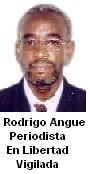
On June 2, coup d´etat trial police authorities banned AFP and BBC freelance correspondent
Rodrigo Angue Nguema from entering the courtroom, even after Nguema showed his press card
(see Section 1.e.).
Radio was the most important and influential medium of mass communication. During the year,
the Government continued to dominate effectively domestic radio broadcasting. It owned and
operated the station Radio Malabo. The President´s son, Teodorino Obiang Nguema, who also
was Minister of Forestry, Environment, and Fisheries, owned the only private local radio station,
Radio Asonga. The Government has not approved the one or two other applications for private
radio stations that have been pending for several years.
Unlike in the previous year, no radio stations were shut down.
The only domestic television station was government-controlled, and broadcast only a few hours a
day. Television Asonga, owned by President Obiang and run by his son in coordination with Radio
Asonga, broadcast by cable only in Bata. Foreign cable television was available, and offered the
Cable News Network (CNN), French news, movies, sports events, and cartoons; however,
relatively few citizens could afford cable. Satellite reception increasingly was available.
The Government generally withheld access to domestic broadcasting from opposition parties and
rarely referred to the opposition in anything but negative terms when broadcasting the news.
International electronic media was available and includes Radio France International, which
broadcast in Malabo, and Radio Exterior, the international short-wave service from Spain. Radio
Exterior often broadcast news about the country and interviews with opposition politicians. It was
virtually the only means for the opposition to disseminate its views and positions widely. Its
editorials, like those of most of the Spanish media, frequently were highly critical of the
Government. The Government regularly accused Radio Exterior, sometimes with justification, of
misrepresenting the situation in the country.
Internet service was available, although access was expensive and computer ownership was not
widespread. During the year, UP Secretary General Fabian Nsue was arrested and convicted of
”slandering” the President in an Internet article.
The Government did not restrict academic freedom.
b. Freedom of Peaceful Assembly and Association
The Constitution provides for the right of assembly; however, the Government restricted this right in
practice. Government authorization must be obtained for private home meetings of more than 10
persons for discussions that the Government considers political in nature. Although the
Government formally has abolished permit requirements for party meetings within party buildings,
in practice opposition parties must inform the authorities in order to hold gatherings of any kind,
regardless of location. Security forces generally monitored gatherings in public places, even small
gatherings. The Government required notification for public events; however, it did not routinely
deny permission for such events.
The Government continued to require that the Catholic NGO Autonomous Rural Development
(DAR) in the diocese of Ebibeyin inform the locally appointed official delegate of each board
meeting. The DAR complied with the requirement and received permission to meet, but the local
delegate insisted on being present during the meetings. During the year, DAR avoided the
Ebibeyin order by meeting in Bata.
The Constitution provides for the right of association; however, the Government restricted this right
in practice. The law prohibits the formation of political parties along ethnic lines. The law prohibits
coalitions between political parties; however, five opposition groups formed a coalition (see
Section 3). Opposition party members complained of disruption of meetings.
There were 12 political parties that the Government called ”opposition parties;” 11 have allied
themselves with the ruling PDGE. The Government advertised these opposition parties as
examples of the country´s multiparty democracy.
The Progress Party (PP) remained illegal due to criminal sentences imposed in 1997 and again
during the year on its leader, Severo Motto, for a coup attempt in 1996. Motto reportedly fled to
Spain. The President invited the PP to organize a new political party under another name; however,
the PP did not do so by year´s end.
The Independent Democratic Socialist Party (PIDS) and the Democratic Republican Front (FDR)
still were seeking recognition.
The Government reportedly applied pressure to persuade opposition members or officials to join
the PDGE party; significant numbers of opposition members joining the PDGE during the year
suggested such practices persisted. Reportedly the Government bribed members of the
opposition.
c. Freedom of Religion
The law provides for freedom of religion; however, in practice the Government limited this right in
some respects.
The law includes a stated official preference for the Catholic Church and the Reform Church of
Equatorial Guinea due to their traditional roots and historic influence in the social and cultural life
of the populace. For example, a Roman Catholic Mass normally was part of any major ceremonial
function such as the October 12 national day.
A religious organization must be registered formally with the Ministry of Justice and Religion before
its religious activities are allowed. While religious groups must be approved and registered in
order to function legally, there were no reports during the year that the Government had refused to
register any group. The approval process usually takes several years, due primarily to general
bureaucratic lag and not the result of a policy designed to impede the operation of any religious
group.
The Government continued to restrict the freedom of expression of the clergy, particularly regarding
any open criticism of the Government. According to Director of DAR, Jose Maguga, Church
representatives practiced self-censorship on these issues during the year. The Government
required permission for any religious activity outside the church building, but in practice this
requirement did not appear to hinder organized religious groups. The Government required that
DAR inform the local delegate in Ebibeyin each time that it had a board meeting (see Section 2.b.).
Religious study was required in schools and was usually, but not exclusively, Catholic.
For a more detailed discussion see the 2002 International Religious Freedom Report.
d. Freedom of Movement Within the Country, Foreign Travel, Emigration, and Repatriation
The law provides for these rights; however, the Government limited them in practice. Local police
routinely extorted bribes from occupants of vehicles traveling outside the capital. The police
routinely stopped citizens at roadblocks, subjected them to searches, and extorted money from
them. Police and solders continued to target citizens of Cameroon, Gabon, and Nigeria (see
Section 1.c.). The Government justified these roadblocks as customs controls to compensate for
its inability to control the country´s borders effectively. These checkpoints effectively restricted the
freedom of movement of members of the opposition. Prior to the presidential election, the
Government re-opened a number of military roadblocks on the island of Bioko between Malabo
and Luba and also in the vicinity of Bata on the mainland.
All citizens were required to obtain permission to travel abroad from the local Police
Commissioner, and some members of opposition parties were denied this permission. Those
who did travel abroad sometimes were interrogated upon their return (see Section 2.a.). On
January 20, the Inter-Ministerial Human Rights Commission eliminated exit visa requirements for
citizens traveling outside the country; however, the Government refused issuance of exit visas to
some opposition figures early in the year.
During the year, President Obiang continued to urge exiled opposition figures to return to the
country and to legalize their parties; however, there were no reports of returnees during the year.
The law provides for the granting of asylum and refugee status in accordance with the 1951 U.N.
Convention Relating to the Status of Refugees and its 1967 Protocol. In recent years, an average
of one or two persons requested refugee status in the country. The Government provided first
asylum and generally granted asylum requests; the Government cooperated with the U.N. High
Commissioner for Refugees (UNHCR).
There were no reports of the forced return of any persons to a country where they feared
persecution.
Section 3 Respect for Political Rights: The Right of Citizens to Change their Government
The Constitution provides citizens with the right to change their government peacefully; however, in
practice there have been no free, fair, and transparent elections since independence in 1968. The
President exercised strong powers as head of state, commander of the armed forces, and leader
of the government party, the PDGE. Impeachment of the head of state is forbidden in the
constitution. Leadership positions within the Government in general were restricted to the
President´s Mongomo clan of the Fang ethnic group and its closest supporters. The Government
completely dominated the elected Chamber of Deputies and the Minister of the Interior also acted
as President of the National Electoral Board.
In 1997 the Government and 13 political parties promulgated a revised national pact that called for
the creation of a multiparty electoral commission and an observance commission to monitor
compliance with the agreement. The pact also stipulated an end to various political and electoral
abuses and the extension of voting rights already nominally provided in the Constitution. However,
the Government has not abided by most of the pact´s provisions, and opposition activists reported
that the Government made virtually no effort to implement the pact. The Government´s refusal to
issue exit visas to some opposition figures early in the year violated the pact´s principle of freedom
of travel and the Government´s own elimination of the exit visa requirement. The continued arrests
of CPDS and UP party leaders further undermined the Government´s claims that it abided by the
pact, as did its continued restrictions on freedom of movement and the continued lack of access to
government media by the opposition (see Sections 2.a. and 2.d.).
The electoral law mandates the replacement of open voting by secret ballots in future elections but
prohibits coalitions between political parties. Nevertheless, five opposition groups including the
CPDS, Front for Democratic Opposition (PSD), PP, Progressive Democratic Alliance (ADP), and
the UP formed the Front of Democratic Opposition (FOD). The formation of this alliance with an
unrecognized party widely was alleged to be the real reason behind CPDS Secretary General
Placido Mico´s detention (see Section 1.d.). Significant segments of the political opposition either
remained banned or had yet to be recognized by the Government by year´s end, including the FDR,
the PP, the PIDS, and the Movement for Autodetermination of Bioko Island (MIAB) (see Section
2.b.).
The last legislative elections that should have been held in 1998 were postponed until March
1999. The three opposition parties initially called for a boycott of the polls to protest pre-election
irregularities; however, all but one of the parties, the CPDS, ultimately participated in the voting.
One CPDS candidate was elected; however, he refused to take his seat after the Government
accused him of rigging the election. International observers considered the 1999 legislative
election process to be seriously flawed and characterized by numerous irregularities and
restrictions on the ability of the opposition to campaign. Roadblocks impeded the opposition´s
ability to travel, and opposition leaders were detained intermittently and sometimes mistreated,
tortured, or assessed stiff fines. The UP and CPDS opposition parties won 5 of the 80 seats,
refused to take their seats in the new legislature, and called for the results to be annulled and new
elections held.
Prior to the December presidential elections, there were reports that arrests and harassment of
opposition party members increased (see Section 1.d.).
President Obiang won the December 15 election, with 97.1 percent of the vote and 98 percent of
registered voters participating. Opposition leaders charged earlier in the year that census results
showing a twofold population increase were flawed and that numbers were inflated to perpetuate
election fraud. Four of the leading opposition candidates published a statement that rejected the
vote and called for new elections. There were widespread reports of irregularities on election day,
including intimidation at the polls. For example, in some towns, commission members gathered
voters and asked whether any intended to vote for the opposition. When none responded
affirmatively, their votes were counted for the President. Voters were discouraged from voting in
secret, ballots were opened, and ruling party representatives reportedly cast votes in their own
right as well as on behalf of minor children and the deceased. There also were reports that
security forces intimidated voters by their presence in polling booths. The European Union (E.U.)
expressed concern regarding the democratic process, severely criticized the way the presidential
election was carried out, and recommended that the Government invite the U.N. or the E.U. to send
an electoral assistance mission.
There were no legal restrictions on the participation of women or minorities in politics. There were
5 women in the 80-member legislature and 3 women in the 41-member cabinet.
Section 4 Governmental Attitude Regarding International and Nongovernmental Investigation of
Alleged Violations of Human Rights
There were no effective domestic human rights NGOs. The law restricts NGOs and identifies
specific areas in which they may operate; human rights was not one of these areas.
CNDH was established by Parliament in 1991 and had as its main responsibility monitoring
respect for fundamental human rights throughout the country. It concentrated primarily on prison
conditions. Unconfirmed sources have said that the Parliament, (”Peoples´ House of
Representatives”), appointed CNDH members.
No international human rights NGO was resident in the country; however, there were signs of
improvement in the relations between some international organizations and the Government.
During the year, the Government signed a convention providing the ICRC regular prison access
(see Section 1.c.).
Catholic Relief Services (CRS) confined its programming to health-related issues, citing safety
concerns for staff and partners. There have been allegations from CRS, Reporters Without
Borders, and the Center for Rural Development that NGO representatives visiting Malabo have had
their movements, calls, e-mails, and faxes monitored (see Section 1.f.).
In August a Spanish volunteer associated with the NGO Central Caritas spent 3 weeks in jail on
charges of espionage after he was arrested in Malabo for viewing, from a public street, solar
panels mounted on a military facility.
During the year, the Government denied requests from Micominsen, a Spanish order of nuns
whose charitable work includes stocking hospitals and providing clean water sources, to enter the
country.
In April the Commission on Human Rights terminated the mandate of UNCHR Special
Representative Gustavo Gallon, despite protest from the international community and the former
Special Representative himself. Gallon stated in his January report that the country should
continue to be monitored, and according to the Commission´s resolution, advisory and technical
support in the area of human rights will continue.
Section 5 Discrimination Based on Race, Sex, Disability, Language, or Social Status
The Constitution prohibits all forms of discrimination; however, both governmental and societal
discrimination against women and ethnic minorities continued.
Women
Domestic and societal violence against women, particularly wife beating, was common. The
public beating of wives was forbidden by government decree; however, violence in the home
generally was tolerated. The Government does not prosecute perpetrators of domestic violence.
Many prisons do not have separate areas for men and women, and women were subjected to
sexual abuse both from the authorities and other prisoners while in detention.
The massive influx of single foreign men in the petroleum sector has contributed to an increase in
prostitution. During periodic crackdowns, police arrested prostitutes but allowed their clients,
generally expatriates, to go free.
Although the Constitution provides for equal rights, women largely were confined by custom to
traditional roles, particularly in agriculture. Polygyny, which was widespread among the Fang,
contributed to women´s secondary status, as did limited educational opportunity.
There was no discrimination against women in formal inheritance and family law; however, in the
Fang, Ndowe, and Bisio cultures, primogeniture was practiced. Because women become
members of their husband´s family upon marriage, they usually were not accorded inheritance
rights. When the husband dies, a widow either remains with his family in a dependent,
marginalized position or she returns the dowry and leaves with nothing.
There was discrimination against women in traditional practice. For an estimated 90 percent of
women, including virtually all ethnic groups except the Bubi, tradition dictates that if a marriage is
dissolved, the wife (or her father or brother) must return the dowry given her family by the
bridegroom at the time of marriage. Tradition also dictates that if a girl´s family accepts a dowry
from a man, she must then marry him, regardless of her wishes. If the marriage does not take
place, the family is required by tradition to return the dowry, which they sometimes cannot do. This
could lead to imprisonment of the bride or a family member for the debt (see Section 1.d.). If a
marriage dissolves, the husband also automatically receives custody of all children born after the
marriage, while the mother maintains custody of all children born prior to the marriage.
According to the law, women have the right to buy and sell property and goods; however, in
practice the male-dominated society permitted few women access to sufficient funds to engage in
more than petty trading or to purchase real property beyond a garden plot or modest home.
Children
No provisions for the welfare of children were legislated. The Government devoted little attention to
children´s rights or their welfare and had no set policy in this area. Education was compulsory
through primary school, but the law was not enforced. In practice boys were expected either to
complete an additional 7 years of secondary school or to finish a program of vocational study
following primary education. Pregnancy and the requirement to assist in agricultural work made
this level of education less likely for girls. Many rural families were unable to afford the school fee
and book expenses for children over 10 years of age. The 1999 report by the U.N. Special
Representative noted that only 12 percent of girls reach the secondary level of education
compared with more than 24 percent of boys. Only 9 percent of girls finish fifth grade. Generally
women have only one-fifth the educational level of men. New schools have opened; however, they
were reported to be without basic materials such as books and desks. Teachers were political
appointees and often received no training. Children suffered poor health and a high mortality rate.
Persons with Disabilities
There was no constitutional or legal provision to protect persons with disabilities from
discrimination in employment, education, or the provision of other state services. While there was
no formal evidence of discrimination against persons with disabilities, anecdotal evidence
suggested that basic care may be withheld when children have potentially disfiguring diseases
such as polio. The law does not mandate access for persons with disabilities to buildings.
National/Racial/Ethnic Minorities
Discrimination against ethnic or racial minorities was not legal, and the Government did not overtly
limit their participation in politics; however, the monopolization of political power by the President´s
Mongomo clan of the Fang ethnic group persisted. In practice some members of ethnic minorities
faced discrimination because they were not members of the Fang ethnic group, or belonged to a
Fang subclan other than the President´s.
Differences among clans of the Fang ethnic group, in particular resentment of the political
dominance of the Mongomo clan, also were sources of significant political tensions and in past
years, of occasional violence.
Beginning on July 24, police forced approximately 500 Cameroonians out of Malabo following
implementation of a new policy concerning nationals of neighboring countries. A government
spokesperson claimed the policy was designed to curb the illegal entry of Cameroonians attracted
by increasing petroleum-led growth.
Several thousand citizens of Nigeria, Ghana, and Francophone Africa continued to reside in the
country. Most were small traders and businesspersons. The police reportedly continued to harass
and extort money from them as well as harassing asylum seekers on an individual basis.
Section 6 Worker Rights
a. The Right of Association
The Constitution provides for the right to organize unions; however, the Small Farmers Syndicate
(OSPA), was the country´s only legally recognized labor union. According to the International
Confederation of Free Trade Unions (ICFTU), the Government never has allowed the registration
of unions; as a result, the Equatorial Guinea Trade Union has been forced to carry out its activities
in secret. There were a few cooperatives with limited power. The law stipulates that a union must
have at least 50 members who are from a specific workplace and located in the same geographic
area to register; this effectively blocked union formation. The CPDS tried unsuccessfully to legalize
its affiliated Syndicated Workers´ Union (UST), and an independent union, Independent Syndicated
Services (SIS), was denied registration despite having met the requirements of the law. In April the
Government shut down a newly created bar association, an action that reportedly discouraged
early efforts to organize a college of physicians.
The 1992 Law of Associations and Syndicates provides that a separate law be enacted to govern
unions for civil servants; however, this law has not been enacted. During the year, the International
Labor Organization (ILO) advised the Government on the formation of professional organizations.
During the year, the country´s major private employer, the oil industry, which was dominated by
foreign firms, continued to take steps to reduce government control of hiring in the industry.
Companies employed methods ranging from public advertising of jobs and objective testing to
screening of applicants by non-citizens only, in an attempt to eliminate the former political bias in
the hiring process. According to regional representatives of the ILO, oil industry efforts largely have
been ineffective, and the Government continued to influence employment in all sectors.
In May 2001, an ILO team met with the Government to discuss reform of the country´s labor laws
and ILO assistance for labor inspectors; however, no subsequent action has been taken.
There was no law prohibiting antiunion discrimination.
b. The Right to Organize and Bargain Collectively
The law provides workers the right to organize and bargain collectively; however, there were many
legal requirements before collective bargaining was permitted, which limited unions´ ability to
organize. There was no evidence of collective bargaining by any group; however, the Labor Ministry
sometimes mediated labor disputes. The Government and employers set wages, with little or no
participation by workers.
The law provides for the right to strike. The Labor Code contains provisions to uphold worker
rights, but the Government generally did not enforce them, in part because of inadequate staffing
in the Ministry of Labor. Apart from the Labor Ministry, workers had few other places to seek
redress. Members of the National Assembly reportedly tried to mediate employer-worker disputes
over wages or dismissals; however, they had no legal authority to do so.
There were no export processing zones.
b. Prohibition of Forced or Bonded Labor
The law forbids forced or bonded labor, including by children, and slavery; however, detainees and
convicted felons performed extensive labor outside prison, including for prison officials, without
compensation (see Section 1.c.).
There were reports that forced child labor occurred (see Section 6.f.).
c. Status of Child Labor Practices and Minimum Age for Employment
The legal minimum age for the employment of children was 14 years, but the Ministry of Labor did
not enforce this law, and child labor was common particularly on family farms and businesses.
The Government also did not enforce the law that stipulates mandatory education through primary
school. Underage youth performed both family farm work and street vending. While the Ministry of
Labor was responsible for the enforcement of labor legislation, the Government did not have a
comprehensive policy on child labor.
e. Acceptable Conditions of Work
Employers must pay the minimum wages set by the Government, and most companies pay more
than the government-established minimum wage. The minimum monthly wage ranges from $100
(75,000 CFA francs) per month for unskilled workers to $1,000 (750,000 CFA francs) per month for
oil sector professionals. The mandated minimum wage in the oil sector was twice the minimum
wage in commercial enterprises, and oil sector workers received a much higher scale than
elsewhere in the national economy, often 10 times the minimum wage. The minimum wage for
unskilled workers was not sufficient to provide a decent standard of living for a worker and family.
The law prescribes a standard 35-hour workweek and a 48-hour rest period, which were observed
in practice in the formal economy.
The Labor Ministry reportedly took no further action on the 2001 case where several employees of
the Malabo city administration sought payment of overdue wages.
The Labor Code provides for comprehensive protection for workers from occupational hazards;
however, the Government did not enforce this in practice. The Government has seven labor
inspectors in Malabo and five based in Bata, which was an insufficient number to oversee local
industry. The Government began training more inspectors in 2001.
Employees who protested unhealthy or dangerous working conditions risked losing their jobs.
f. Trafficking in Persons
The law does not prohibit trafficking in persons, and reports that the country increasingly was a
minor destination and transit point for trafficked persons continued. The government sent
representatives to Libreville to attend a regional conference on trafficking in persons; however, no
legislative or policy changes had resulted by year´s end.
Children primarily were trafficked into the urban labor sector in Malabo and Bata, mostly from
Benin and Nigeria. Benin girls between the ages of 12 and 16 worked 12-hour days selling
cosmetics on the streets of Malabo. These girls often were unpaid and physically mistreated.
Nigerian boys worked in market stalls in Bata, often without pay or personal freedom. UNICEF
reported that country served as a transit point for children who were trafficked to Gabon. The
country was both a destination and a transit point for trafficked women, mostly from Cameroon,
Benin, and Nigeria. Women were trafficked into hubs of prostitution to serve the growing
businessman population in Malabo.
Fuente: ASODEGUE







 Seguir a @guinea_net


